Reviews
“Stuart Gosswein usurps a pope.”
— Mark Jenkins, September 9, 2026
Following the opening of Stuart Gosswein: Five Decades of Art, veteran arts writer Mark Jenkins, based in Washington, D.C., featured the exhibition in his DisCerning Eye Substack review, “Material Issues.” His thoughtful commentary highlights the remarkable range of Stuart’s work and the breadth of materials, styles, and ideas brought together across five decades of artistic practice.
Material Issues
Mark Jenkins | DisCerning Eye | September 9, 2026
STUART GOSSWEIN’S EXHIBITION AT CARROLL SQUARE GALLERY is a one-man show, but it appears to be the result of multiple artists. Rather than document a unidirectional stylistic evolution, “Five Decades of Art” demonstrates a protean ability to vary modes, media, and motifs.
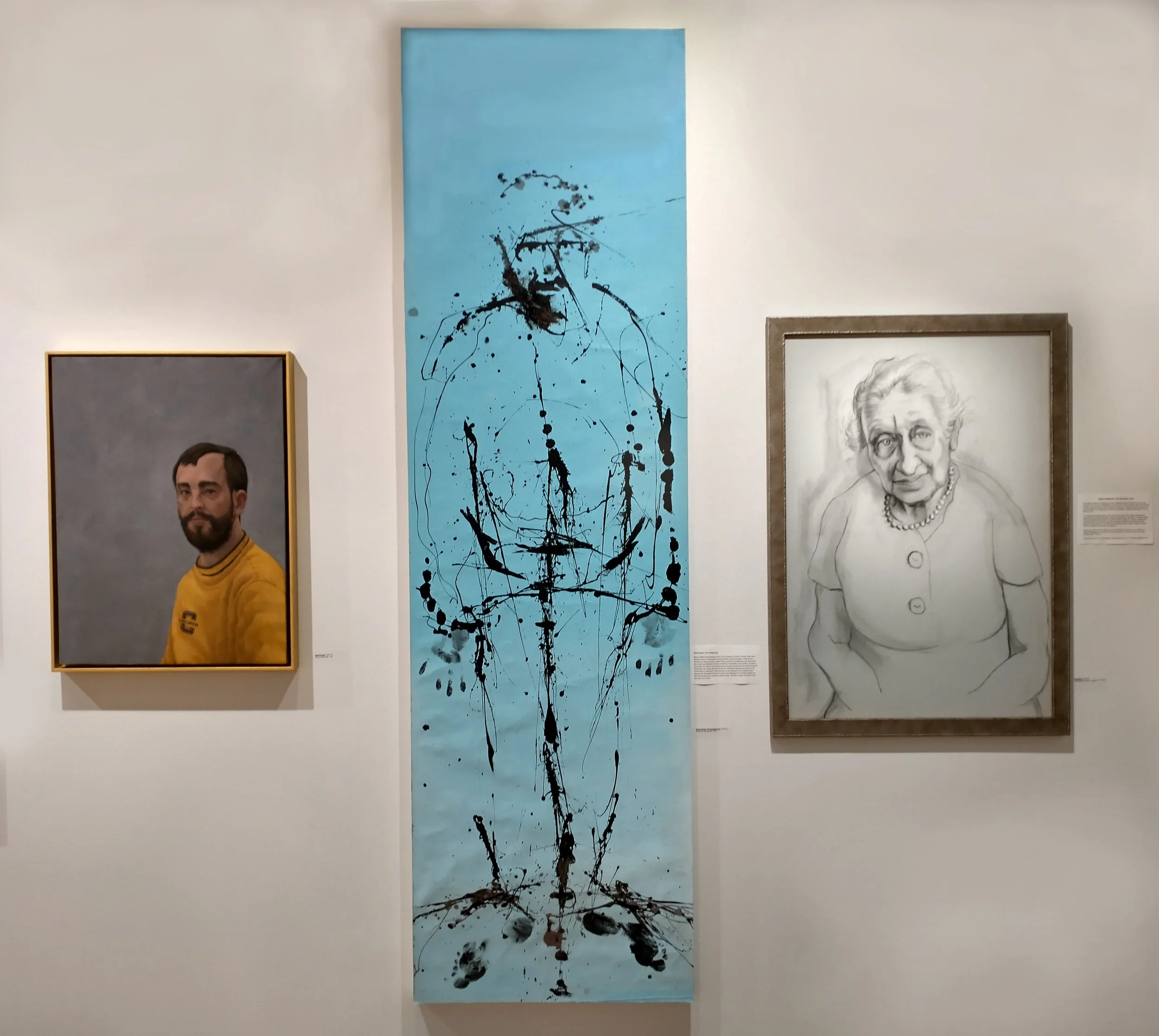
To be sure, there are recurring themes, notably visual autobiography. Nine of the 32 entries are partly or entirely titled “Self Portrait,” and Gosswein sometimes interjects himself into incongruous art-history contexts. One of the artist’s favorite paintings is Velasquez’s masterly portrait of Pope Innocent X, also an inspiration to British painter Francis Bacon. Gosswein’s renditions of Velasquez’s picture include some in which he stands in for the 17th-century pope. In a puckish interpolation, the artist wears a red hoodie instead of Innocent’s silky cap. (The National Gallery of Art owns a version of the papal portrait, which is credited to a follower of Velasquez but which Gosswein believes is by the great painter himself.)
Gosswein frequently depicts animals, notably horses, whether precisely or very loosely. “Statuesque Horses,” with its bold black lines and metallic tints, is particularly striking. Among the most detailed paintings is a upward-gazing view of the Federal Triangle, which is painstakingly realistic except for one thing: For the sake of the composition, the artist shifted the Washington Monument a few blocks east.
Although Gosswein estimates that 30 percent of the art he’s produced is abstract, this show emphasizes representational work. The influence of abstraction can be seen primarily in such freely painted pictures as the brushy “Three Sea Gulls” and a sketchy self-portrait made of black blotches on a blue field. “Six Apples” is modeled on a 13th-century Chinese ink painting, but its mottled background channels abstract expressionism. Injecting a hint of Jackson Pollock into a homage to ancient Chinese art may seem a brash move, but hardly as cheeky as Gosswein’s sitting himself in the place of a notable pope.
— Mark Jenkins, DisCerning Eye
Read the complete article, Material Issues → Mark Jenkins, Discerning Eye